In conclusion, Vipassana was a powerful and deeply fulfilling experience for me. I have every intention of going back as a student or to serve, and am working to make mediation a part of my daily morning ritual. I hope this account of my experience is helpful for those considering taking the 10 day course, and highly recommend it to those willing to work hard and put in the effort to succeed.
Sunday, September 11, 2016
My Vipassana Experience
In conclusion, Vipassana was a powerful and deeply fulfilling experience for me. I have every intention of going back as a student or to serve, and am working to make mediation a part of my daily morning ritual. I hope this account of my experience is helpful for those considering taking the 10 day course, and highly recommend it to those willing to work hard and put in the effort to succeed.
Sunday, October 23, 2011
Metaphor
Wednesday, October 5, 2011
Sustainability in Growth Markets
Today, the Earth’s ecological footprint is 23% over capacity.* The growing gap between human demands on the environment and our planet’s ability to meet them necessitates that organizations monitor, and measure their carbon footprint. This is particularly true in high growth countries, where currently, growth is still measured in purely financial terms that do not account for the cost of environmental degradation. After reviewing the national agendas of over 30 growth markets, only 5 (ANZ, China, Austria, and Philippines) cited environmental issues among their top priorities. For growth markets to prioritize sustainability, they must monitor and manage their environmental impact in a way that directly correlates it with profitability. Sustainable practices will only become attractive to growing organizations in these countries if they contain cost cutting or revenue enhancing incentives. But for the relationship between sustainability and profitability to become clearer, sustainable business practices must be just as measurable as the financial gains they produce. If one thing is apparent from the absence of sustainability as a priority item in most of these countries, it is that the limitations of our planet's natural resources have yet to be given the importance they deserve.
To comprehensively measure an organization’s carbon footprint, analytics must be applied across the company’s value chain; extending beyond its operations to those of its suppliers, customers, and even its disposal practices. Existing product life-cycle management software (PLM) is only a partial solution because business leaders use it as a one dimensional “measuring stick”; rarely using it to influence decisions that extend beyond organizational boundaries.
Such all-encompassing carbon footprint measurements require an analytical culture. The pervasive use of analytics throughout a value chain enables a carbon footprint measurement comprehensive enough to correlate with long-term financial performance. Nowhere in the world are such implementations more important than in growth market countries, where the growth in demand for natural resources is expected to increase the fastest.
Monday, July 5, 2010
Consonance
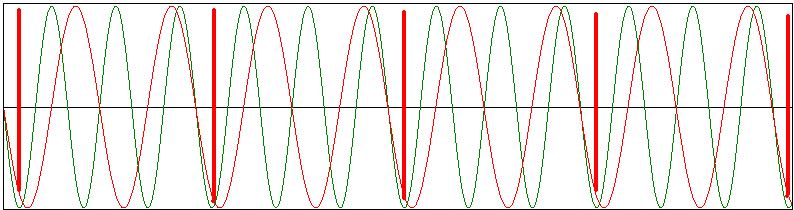
Look closely at this graph. I have put red lines in this picture, to show the repeating pattern. Is the presence of this pattern the reason why C and G sound "good" to us? Secondly, the ratio of G to C is 3/2 (261.6 Hz / 392Hz). This means that every 3rd wave of G matches up with every 2nd wave of C. This phenomenon is commonly addressed in music theory and is explored is much more detail here.
While we could delve into the musical and mathematical explanations of this, I am much more interested in consonance as a phenomenon in nature. Where else might we observe it? If in music, one of the characteristics that allows notes to sound "right" together is a repeating pattern, would it be stretch to say that repeating patterns are naturally attractive to humans in completely different contexts? To push the idea further, would it be a stretch to say that the ability to recognize and understand patterns is a fundamental characteristic of human intelligence? The Mensa workout quiz tests for this, for example.
If musical consonance is any indication of the importance of patterns, it may be useful to find examples of consonance in different aspects of our world. In order to find these examples however, we would no longer be able to focus on discrete events, but would instead have to observe the connections between disparate pieces of information to identify unexpected relationships. Like music, such systems would no longer be viewed as linear, cause and effect events but rather systemic associations - just like systemic associations between repeating patterns in musical notes, and their resulting effect on pleasant sounds.
As a businessman committed to sustainable enterprise, I have to wonder if it is possible to manage an organization by using systemic interrelationships as its guiding principles. Would it be better to view a problem or inefficiency in a business as systemic issue that can be solved more effectively by identifying its patterns and influencing its related components? Many business managers today are comparatively reactionary; focusing on problems as discrete issues with "band-aid" fixes. Rather than use such an approach, business leaders would strive for "harmony" across departments in their company; the same way that musicians strive for harmony across notes and chord progressions. Modern ecologists have to apply a similar principle in their jobs. To balance natural ecosystems, they must view them as dynamic, interrelated communities of different species. In the horrible catastrophe that took place in the Gulf of Mexico recently, top leaders in marine ecology have accounted not only for immediate impacts on the ocean's health, but have also accounted for patterns from previous natural disasters in a unique bio-remediation-based approach to this one. This is yet another example of how identifying systemic interrelationships can help us solve problems more effectively.
I hope that none of this sounds too far-fetched. As we speak, the worlds largest companies are mobilizing themselves to utilize more computing power. They will be using this computing power to analyze vast data sets to identify patterns and systemic associations across systems. Can we learn something by observing patterns in one system, that we can apply to the business world or to sustainable enterprise? I believe we can.
Friday, December 4, 2009
Clarity through Altruism
-James Allen
Empathy may alleviate some of the challenges associated with perceptual difference. It helps a company identify with the thoughts, feelings, and attitudes of another person; customers or not. It helps us experience the world through their skin and reason through subjective issues with another value system. In order to truly empathize with another person, we would have to trust that their perspective is pure; untainted by superficial ideas and trivialities. Trusting another person enough to "know" that their lens will provide more clarity than distortion, seems to be a matter of judgment. But is it unreasonable to propose that empathizing with anyone provides insight into reality beyond what we experience on our own? I guess the only way to tell for sure would be to reassess the accuracy of our own perceptions after empathizing with another person. If the result on our own perception is positive, it may be safe to assume that we now have a more accurate interpretation of reality than before. If however, the result is negative, empathizing with this other person might ultimately have been distorting. A distortion here, however, must be carefully considered before it is discarded; resulting ultimately in more clarity. Accordingly, any empathetic thought or action either causes us to experience reality from another perspective, or forces us to consider the accuracy of that perspective by reassessing our view of reality.
And who knows? Altruism might ultimately even have a permanent place in the business world.
Wednesday, November 18, 2009
Virtualization
Consider first, that business innovation has accelerated in recent years with the emergence of faster technology deployment, more integration between disparate systems, and the rapid surge of world-class human talent into the high-tech industry. Because virtualization reduces the need for organizations to ramp-up expensive physical resources in order to deploy new technology, the adoption and use of new applications is much faster. As these new applications are integrated into a company's business processes, business capabilities are enhanced and overall efficiency increases. With the resulting improvements in productivity and collaboration, the business case for virtualization extends beyond cost savings and into organizational effectiveness.
Second, the architecture of an organization becomes more flexible as a result of virtualized applications. Businesses which experience "spikes" in IT requirements (ticketing agencies during big concerts, toy stores at Christmas, health-care data centers during flu season, weather centers during hurricanes, etc.) no longer need to design their IT architecture around their maximum computing requirements. With more reliance on virtualization, IT infrastructure can be made more resilient and handle demand spikes. Businesses can continue to operate without worry of exhausting their IT resources due to limitations in physical infrastructure.
Third, and most fundamentally, consider that the core of a business process no longer relies on a machine, but rather a piece of intellectual capital. What does this do to the business world in which we operate? Would the increased "liquidity" of intellectual resources in this cloud of processing power and data storage be bound by the same rules of supply and demand as all other economically driven processes? While it may sound rather far-fetched, I would like to propose that if a company's intellectual capital IS its product, and that intellectual capital is no longer bound by resource constraints in the physical realm, the traditional axiom of supply and demand is no longer applicable. If companies were able to break free from this fundamental productivity contraint simply by shifting their products to those of a more intangible nature, the business landscape would be changed forever.
Business productivity that relies on physical materials tends to be linear in relation to infrastructural investments. The increased data liquidity that virtualization enables changes the way that data centers and consequently businesses, architect themselves for the future. In addition to aforementioned gains in productivity and technology deployment, the fluid and highly cooperative nature of virtualized environments will inevitably lead to symbiotic relationships between different business applications...an evolution of sorts. It is interesting to note that we have already observed such transformations in biological systems...but that's another blog post.
Tuesday, November 3, 2009
Market Correction
Saturday, September 19, 2009
Cognitive Surplus
If we consider the amount of time invested by people to generate content who would have otherwise exclusively been media consumers, it would be an interesting exercise to measure their "cognitive surplus". Shirkey defines cognitive surplus as the amount of intellectual capital that could have been used for productive purposes but was instead diverted towards unproductive areas. To put this in terms of a simple example, if all people watching television during a given year were using that time to create a piece of intellectual capital (such as that in a Wikepedia article), how much more knowledge could be proliferated throughout our society?
So some simple math...
Pure production (Wikipedia): All of wikipedia represents approx. 100m hours of thought (IBM statistic)
Pure consumption (Television): 200B hrs. of TV watched in the U.S. each year (US Census statistic)
Latest English article count in Wikepedia (9/20/09) - 3,038,292 articles
100m hrs. / 3,038,292 articles = ~33 hrs. per Wikipedia article
200B hrs per year / 33 hrs. = ~6 million Wikipedia articles per year
So...6m articles + 3,038,292 = ~9m Wikipedia articles
So if everyone in the U.S. stopped watching TV for an entire year and instead used that time to create Wikipedia articles, we would be able to triple the size of Wikipedia's body of knowledge within 1 year. That's a lot of cognitive surplus!
Thursday, August 6, 2009
Culture & Efficiency
Consider China; with its deep historical roots alongside considerably less genetic diversity within its population. In the modern world, China has been the epicenter of manufacturing efficiency and cost reduction through economies of scale. When it comes to taking a proven process, and refining it until maximum benefit has be extracted for the lowest cost, China has developed a level of expertise found nowhere else in the world. Their mastery of manufacturing has become so pervasive that we can observe it in everything from computers to clothing. Such efficiency requires a lot more than well-designed factories or reliable materials suppliers. It requires similar ideologies and parallel thought paradigms among the workforce. With 98% of China's population being "Han Chinese", there is a high level of ethnic and cultural unity in the country. In fact, a study conducted by the National Center of Biotechnology Information showed that Han sub-populations in different regions are genetically close to local ethnic minorities. Is it a coincidence that a country this homogeneous has been able to master efficiency and repeatability?
Contrast this with a distinctly different culture: The United States. The "Melting Pot", often touted as the most racially, ethnically, religiously, and genetically diverse country in the world which coincidentally, also boasts a high proportion of free thinkers and non-conformist eccentrics. With such an eclectic population, how does US manufacturing efficiency compare to China's? While the U.S. is currently the world's largest manufacturer (as of 2008), this may not be true much longer. Just 4 days ago, it was announced that Chinese manufacturing is likely to surpass the US within the decade. While economists might attribute such a shift to cheaper labor, lower taxes, and favorable foreign exchange rates, culture is rarely considered to be a explanation of why Chinese manufacturing is so successful. To illustrate; the US has had a ratio of manufacturing output to GDP between 16% and 19% since the 1940s. Productivity gains during this time have largely been the result of increased automation and "outsourcing". China, on the other hand, has readily invested in manufacturing with human capital in addition to automation. 350,000 additional engineers join the Chinese workforce each year, for example.
In light of this, what kinds of disciplines is the US currently excelling in? Innovation-centric outputs such as music, film and art, seem to thrive in the US. In these disciplines, creative vicissitudes define productivity and individuals are granted the luxury of time and resources. With its credit-leveraged prosperity and obsession with "cool", the US provides such an atmosphere quite effectively. Not surprisingly, this country is the ganglion of the world's media and entertainment industry, and generates creative input for pop-culture internationally. In film, music, fashion, and often art, the US often defines the standard. Does the abundance of cultural diversity here drive this creativity? Moreover, does reduced cultural homogeneity impede our manufacturing efficiency?
Irrespective of the many opinions on this matter (and I'm sure there are many); in considering the economic shifts we are observing in our world today, any economist would be remiss if he/she did not consider the cultural context of an economy before assessing its productive potential.
Monday, July 27, 2009
Biomimicry
According to Czech philosopher Radovan Richta, technology evolves in three stages: tools, machine, automation. This evolution, he says, follows two trends: the replacement of physical labor with more efficient mental labor, and the resulting greater degree of control over one's natural environment, including an ability to transform raw materials into ever more complex and pliable products. Let's think about this for a second: "Transform raw materials into ever more complex and pliable products" and "exert control over one's natural environment." hmm...
So if technology allows us to exert control over our environment, are we now the arbiters of nature? If we can manipulate our surroundings to such an extent, that the forces of natural selection no longer determine survival, has biological evolution stopped? In considering this, it is important to note that dependence on technology is almost a prerequisite to survival for many people today. Much of the middle east would not be habitable without technologically driven infrastructure for water. The world's 6.9 billion people could not be fed without genetic engineered plants for higher crop yields. Hell...I might not make it through a Wednesday without my triple grande nonfat macchiatto in the morning.
It is important to note that there is a very serious conflict of interests here. As technological evolution continues to manipulate the environment by transforming raw materials into complex products, its effect on the balance of natural ecosystems is destructive. While our cultural needs have evolved to rely increasingly on technology, our physiological needs as organisms remain largely unchanged since the Cambrian Era. In light of this, one must ask: Is the current form of technological evolution sustainable? I would argue that a fundamental shift in our view of technology is required to address this conflict between nature and technology. I *would like* say that a fundamental shift in nature is required to address our reliance on technology, but alas...natural design is the product of 3.8 billion years of refinement and above all else, has stood the test of time. Would it be possible then, to leverage natural design principles to "evolve" existing technology?
Enter - Biomimicry. Biomimicry is an ideology that takes inspiration from nature to help make technology more sustainable. Read about it here.
Saturday, July 11, 2009
The Brotherhood of Man
Imagine the following for a moment:
Its 7:30 in the morning. You're still a bit tipsy from a night of debauchery and lacking your usual coordination. Your mouth still sweet with Sangria and the intoxicating scent of vomit, sweat, and urine surround you. You hear a rocket; signaling that six bulls ("Los Toros") and six steers have been released to kill you. With the Sangria still sloshing around in your stomach, you run as fast as you can, but rough cobblestone roads and slow runners in front limit your pace. The bulls run at about 15 mph (fast) and if you find yourself in a section of the run with no balconies to hang from or barriers to climb, you just might get gored. If you're actually able to outrun the bulls, you will complete the run and arrive in a bullring with about 100 other equally drunk men and a roaring stadium. Don't relax just yet...because once the last bull enters the ring, the gates will close and you will be locked in with nothing but the red and white clothes on your back and maybe a newspaper.
Ever wonder what a bunny rabbit stuck in a cage with a Kodiak bear feels like?
For the next hour, a series of angry bulls will be released upon you and your bull-running brothers. As everyone torments the bulls with newspapers and drunken ramblings amidst a thundering stadium, it gets angrier and angrier until it finally tires....at which point this bull is taken in and another "fresh" bull is released. This entire hour involves chasing the bull with a newspaper or running for your life (literally) from one end of the ring to the other. The experience of being petrified, encircled by thousands of hollering fans is nothing short of surreal. The ground reverberates each time the 2,000 lb. bull collides with a person, wall, or steer. If you touch the bull or grab its horns, you will be attacked by EVERYONE ELSE in the ring and the crowd will cheer on as you lay in the dirt like a defeated gladiator. Battle scars are admired and getting trampled wins you a helping hand. People getting tossed 10-15 feet in the air and run over are common occurrences and if you are able to leave the ring without at least a bruise or two, consider yourself a lucky man. After the last of the 7 bulls have been unleashed upon the men and the gates open, there is an overwhelming feeling of camraderie. High-fives abound - you may not know anyone except your friends, but for next five minutes, every man in that ring is your brother. So why would anyone ever do this to themselves? Well, its for that last 5 minutes.
Sunday, June 28, 2009
Intrinsic Love
But what if the experience of love is the same, irrespective of context? What if the array of feelings associated with love actually result from society's need to differentiate between what feelings are appropriate for different types of relationships? Do infants feel love for their brothers and sisters the same way they feel love for their parents? In this view, love for a friend would be no different than love for a parent or a sibling. While the difference would lie in varying intensities of love, the fundamental understanding of love between all people would be the same. Every love would be, for lack of a better word, intrinsic. The all-inclusive english term "Love" then, would not be broad at all. It would be quite accurate.
- Agapē refers to a general affection. It can be described as the feeling of being content or holding one in high regard.
- Eros is passionate love, with sensual desire and longing. It can also apply to dating relationships and marriage.
- Philia means friendship. It is a dispassionate virtuous love, and includes loyalty to friends, family, and community.
- Storge means "affection" in ancient and modern Greek. It is natural affection, like that felt by parents for offspring.
Thursday, June 4, 2009
Simplicity
Every once in a while, an idea comes along that presents a very practical solution for a large-scale, mainstream problem. Longboarding for urban transportation is one such possibility. Almost as fast as a bicycle but much more maneuverable and portable, a longboard is a practical and simple alternative to walking, bicycling, and even short drives. Unlike skateboards designed for ollies and tricks, longboards are much safer and more stable, even on less than perfect roads. They are quiet, easy to use, and do not require any more infrastructural development than the existing bike lanes and sidewalks that are already common in most cities. Beyond learning how to push and turn, longboarding is easy enough that almost any middle-aged office-goer in a suit and tie could half their walking time to work and reduce their reliance on more carbon-intensive forms of transport. In comparison to a bicycle, it is skirt-friendly and doesn't have any greasy gears or sprockets to dirty your pants. Learning to use one requires much less commitment (and money) than that needed for a bicycle or a car and for an innovation with so many benefits, it is almost suspiciously simple!
The problem of small scale transportation has been addressed by a myriad of relatively complex innovations ranging from Smart cars to Vespa scooters. As a resident of Manhattan, I have been intrigued by the recent popularity of "Segway" (www.segway.com) transporters. An electrically powered short-distance "personal transporter", this rather complicated piece of technology relies of accelerometers and gyroscopes to to balance itself and its passenger. It is powered by lithium ion batteries which can be recharged at proprietary charging stations. While it is often marketed as a "zero emissions vehicle", it is important to note that the energy required to charge it comes from your local coal-fired power plant and relies on the same antiquated, carbon-intensive energy infrastructure that emits millions of tons of greenhouse gases into our atmosphere. Having ridden one, I would say that its probably more difficult to ride and less safe than a longboard. While it does propel you at about 10mph, this is approximately the same speed as a longboard. In considering the complexity in the design of a Segway (accerlerometers, computing power, lithium batteries, etc.) one must ask; what is it about the urban congestion problem that warrants such a technologically sophisticated solution? And what additional transportation benefit would this solution have over a longboard, to justify its environmental impact?
Given the practicality and benefits of the longboard for small-scale transporation, it is remarkable that such a practical solution to the urban congestion problem has not achieved as much mainstream market penetration as the Segway. With such simplicity in its favor, it is unlikely that this is due to any functional deficiency in longboard design, but rather due to the perception of skateboarding in the public eye. I would like to suggest that the stigma associated with skateboarding (juvenile, rebellious, anti-establishment, etc.) is the primary obstacle to the adoption of longboarding by the mainstream market. To illustrate, I wear a suit to work on most mornings and having skated up to my building and walked into the office with my longboard, I have had colleagues question my "maturity". Even some Police departments, having adopted Segways for their patrollers (See: http://www6.miami.edu/UMH/CDA/UMH_Main/1,1770,37515-1%3B52931-3,00.html) likely did not consider the longboard due to this stigma.
The shift toward simple transportation is not a comfortable one. In order for the mainstream market to adopt longboarding, it will have to shed predispositions and adopt a new thought paradigm. One that values originality, function, community, and the beauty of natural esthetic. In this view, creativity and spontaneity will prevail over uniform technical standards and complicated machinery. An example of such principles in action today is company called Bustin Boards (www.bustinboards.com). Bustin is dedicated to the cause of environmental preservation and natural design. As artistic innovators of the longboard, they are successfully overcoming the stigma that longboarding faces with originality. A growing community of longboarders and artists committed to environmental preservation, Bustin represents a model of ideals for a sustainable future. Much respect Bustin!
The truth is that simpler is, in fact, better. Its more efficient, more reliable, and more carbon neutral. Complexity requires the kind of foresight that architects, engineers, and scientists have never had in the past, and this is what has led us to the unsustainable practices of today. There is an overwhelming need for our society to revert back to its roots and stop relying on resource-intensive technologies with marginal benefit. This shift can only be made with a commitment to the environment under a new thought paradigm, such as that exhibited by Bustin Boards. While the longboard is one way for society to make this shift, there are many more if we shed our biases and think openly. In doing so, I'm sure that many people will observe what I did; that the most compelling solutions to large-scale, mainstream problems are unexpectedly simple.
Saturday, October 4, 2008
Financial Myopia
Today, the United States finds itself disillusioned by an idealistic image of prosperity. Having molded a society based on single-minded profiteering, only to be let down by an economic collapse so severe, that the fundamental business models of large standalone financial institutions is being questioned. These institutions, which have represented a great and prosperous nation, find themselves grappling to keep their noses above water. Highly leveraged, and surviving on capital created from inflated valuations, their leaders have failed to realize that even in the age of Globalization, business must support the nation in which they were founded and in which they flourished. To humanize this notion, this principle is synonymous with “Work for your family and support your roots, not in spite of them”.
A significant shortcoming revealed by leaders of these institutions is that they have failed to collaborate with the nation’s regulatory bodies; viewing the legal structure in business as a hindrance to profitability and growth. A sound regulatory structure is viewed as a business benefit only inasmuch as it enables transactions and controlled liquidity in the capital markets for large enterprises to operate. As momentum grows, increased regulation is required to prevent corruption and deceit, accounting scandals or otherwise. When regulatory bodies evolve to match the scale and complexity of financial transactions, a tension between the profiteering interests of business and the integrity-ensuring interests of regulatory bodies collide. This is where the leaders of financial institutions have failed the country, and ultimately their own institutions. With a rash disdain for laws such as SOX, GAAP frameworks, and the like, they have failed to see the importance of such regulation for the long-term (read indefinite) sustainability of their enterprises. Further, they have failed to see the immense impact their enterprises can have on the country’s economy at large. These leaders have been plagued with a single-minded focus on generating capital, which has led to vague and unstructured business models based on unreasonable levels of speculation. While much of this has taken place due to competitiveness in the markets, many such models have been created largely to circumnavigate the country’s legal framework through sheer complexity.
Partnering with politicians without the objective of helping advance favorable, “business friendly” interests is considered poor business logic. Corporate backing of political parties through monetary gifts and public support lacks even the faintest hint of patriotism, implying only a single-minded, profit-seeking bias. While decisions to support political parties might promote the short-term success of a single large enterprise, they are not sustainable once companies achieve the size and momentum that many of the premier American financial institutions have attained. The enormous impact such enterprises can have on the nation’s economy requires their leaders to support political parties with patriotism (not profiteering) as their underpinnings. More importantly, they must do this in spite of any short-term consequences that any proposed regulation by that political party may have on their next quarter's income statement. The prevailing perspective that patriotism takes a back seat to business lacks the perspective required for an indefinitely sustainable enterprise. This principle holds true despite the effects of globalization, and becomes increasingly important as the economic impact of institutions on the nation at large increase.
Sunday, October 14, 2007
Underutilized Synergy
"The value of a network is proportional to the square of the number of users of the system."
-Robert Metcalf
As real-time communication between vast numbers of nodes (people) throughout the world becomes a reality, the power of this principle will become exponentially more apparent. The reaction time of entire organizations will reduce and the landscape will allow anyone to compete with anyone else. Identity management will inevitably become an overwhelming concern, while a node's geographic location will only be important for knowledge acquisition. But what happens to the people at these nodes? Physically, they are all staring at a computer screen sending and receiving pieces of information. The purely intellectual involvement of people in work is not natural, and its physiological effects ultimately limits productivity. Example: The same architect who, no more than two generations ago, would have been playing with blocks, sticks, and paper to design a house, is now staring at a computer screen using computer software to “build” a piece of intellectual capital, which will ultimately be used to build a house. Is creativity hindered, bolstered, or left unchanged? With lower levels of physical involvement in work, blood circulation slows, hand-eye coordination is redefined with a mouse/keyboard, and energy levels decrease. Daily exercise, while extremely beneficial for maintain health, is rarely coordinated with intellectual activity. The end result for the individual at a node is better networking capabilities, combined with lesser contributions to the network. Networking enables synergy, but what is the cumulative power of people when intellectual faculties are not being fully-utilized?
Tuesday, October 9, 2007
Change
The process of change can be viewed in two ways: inside-out and outside-in. The latter is comprised of endless trials, innumerable errors, extensive documentation, probabilities, major resource investments, and most importantly, hope. The former is the result of enlightened action; a "knowing" of exactly how to respond to a particular change in the environment, avoiding trial and error. In considering biological evolution, Darwinianism is an example of the outside-in approach. Mutations, most of which are unsuccessful, fail until one ultimately succeeds at helping an organism adapt to its environmental conditions. In business, however, market research and analysis provides us with a view of the market environment; a luxury not available to living organisms that don't have access to the Weather Channel. A company's response to market conditions is not a "shot in the dark" as it is in evolution, but rather a calculated action with probabilities of success associated with it. Such "enlightened" change can only occur through an accurate view of the market conditions. The accuracy of that view, then, is paramount.
Tuesday, September 11, 2007
Clarity
I just got back from Bombay and Goa, India where I met Bollywood movie stars and Sai Baba of Shirdi, and you don't get any pictures..haha!
Tuesday, June 19, 2007
Mistakes
They say there is no way around this. We all make mistakes...damn I hate that phrase. Some even go so far as to say that this is a good thing. This is how you learn, they say. What a bunch of hooey! Mistakes are bad. Dress it up with sugar and chocolate frosting all you want but when you make a mistake, it is a bad thing. Hopefully you'll learn not to make the same mistake again. Hopefully the mistake won't be one where you'll experience lifelong consequences. Hopefully, you'll recover....hopefully. I guess there are two ways to view this.
First is in a psylo. A mistake, in and of itself. You do something that results in a a bad feeling for you. So you think "Hmm....that was not so fun.". End. What good can come of this? Well, without this negative emotion following the mistake, we would never associate bad feelings with this purportedly bad action. So I guess that's a positive, right? Associating bad feelings with bad actions will (we hope) prevent you from participating in these bad actions again...thus avoiding the bad feelings.
The second way to view a mistake would be to analyze the cumulative effect of many mistakes on your persona. The cumulative effects of multiple instances of associating bad feelings with purportedly bad actions. I would imagine that this affects a person in a restrictive way.
Since a mistake prevents a particular, purportedly bad, behavior, a series of mistakes prevents many, purportedly bad, behaviors. So the end result is that a person avoids many of these behaviors. Now lets apply this to the ever changing dynamic of life. Since mistakes don't cause a person to behave in a different way, but rather cause a person to not behave in a particular way, how do we know that the avoidance of that, purportedly bad, behavior will always be good? For instance, let me use the worst possible example I can think of. One of those snipers that was running around in Atlanta a few years ago points a gun at a crowded bus from afar. He shoots and kills an innocent person. He gets caught and put in jail. "You're a bad man" they tell him. "Bad bad bad". So he thinks "I better not do that again when I get out of the slammer. If I do, I'll get put back in the slammer and get all these bad feelings again. I made a mistake by thinking that shooting my rifle at a bus full of innocent people was okay." So one day he gets out of jail and he is avoiding shooting a rifle at a crowded bus. One day he spots a crowded bus from afar, full of terrorist suicide bombers, all with those dynamite vest things strapped to them, driving full speed towards a building full of innocent people. He just happens to have a rifle on him because...well...he's a sniper. "Should I pull out my gun and shoot?" he thinks. Having previously associated bad feelings with this, purportedly bad, act, he avoids taking out the rifle and the worst case scenario takes place. Little does he know that criminal law provides "defense of others", as a complete defense against manslaughter charges.
This is, of course, a ridiculous example. However, the point I'm trying to make is that while the cumulative effect of mistakes on the psyche are restrictive in the strictest sense, their resulting effect on behavior may not always be a good thing. There are situations when a person has to look back on their life and reassess the lessons they learned in the past against new situations.
Thursday, April 19, 2007
Decisions
Everyday, we make a series of choices. These choices reflect our beliefs about the world around us and allow us to move in our intended direction. Decisions differ from choices in some very important ways. A decision is a categorical choice. It is one option out of a limited number of options. There are limits; boundaries within which we much elect a path. A choice, however, is borne of nothing. It enters our mind sporadically. Its only limitations are those we impose it from our own beliefs. Fear, hesitation, insecurity, and anxiety are the kinds of emotions that limit our choices. One of the most beautiful things about young children is that they have not had the time to develop these restrictive sensations. Living a moment without worry of the next is where bliss lies; and this is where we lived as children. Bringing it back seems difficult (if not impossible). Plagued with memories that highlight our inadequacies and lower our self-esteem, we “grown-ups” focus on consequence. Consequence unfortunately, lives only in a moment that has not yet taken place; the future.
So being the pessimistic fortune-tellers that we have learned to become through the traumatic process of “growing up”, we have lost focus on NOW. And losing focus on now hinders our ability to make a choice that is pure and untainted by our tendency to consider consequence as a part of the equation.
A man once walked down the street and heard a loud bang from his right. To his left, a person fell from what had turned out to be a gunshot. Two years later, the same man walked the street and heard a loud bang from his right. Immediately, he looked left anticipating another person wounded, and reflexively ran for cover. The bang was, in actuality, a backfiring Harley Davidson. This man’s mind had unfortunately been tainted with a rather unlikely result. Like Pavlov’s dogs salivating at the ring of a bell, he had internalized an outcome from an illogical association.
Similarly, we grow up. We experience many things; some unlikely events. And our choices become more like decisions. Predictability sets in. Imagination muscles get weak. Creativity takes a back seat to redundant motions. My solution? Snowboarding!!!!
Saturday, April 7, 2007
Friends
Subconsious....what a concept. The gut feeling. They say to always trust it. Some of the greatest businessmen in history have preached the importance of trusting their gut. So what is this gut? Subconsiousness? Is this a product of our environment or genetics? Or possibly an interaction of the two. Can this gut feeling be taught to children at a young age or do people with strong gut reactions have children with strong gut reactions? I'm going to go out on a limb here but I think it has to do with a person's attitude; the outward facing thoughts that a person has towards the outside world. Something like "I want to take as much as I can for myself" (Kenneth Lay), "I want to help as many people as possibe" (Florence Nightingale), or "I want to have as much fun as possible" (Keith Richards). People have different and distinct attitudes and I would imagine that these attitudes are unique to the person who has them. Since teenagers rebel and ultimately become just like their parents (especially if they expressly TRY not to be like them), I am led to question whether attitudes are borne of genetics or childhood environment. So just to be safe lets just say its a result of genetics and environment.
So success in making friends...is this simply a consequence of success in the mixing of two attitudes? If this is true, then theoretically, we can be friends with anyone with a little "attitude adjustment". But if attitude results from genetic/environment interactions, then attitude adjustment is impossible. I guess this is where we draw the line between friends and acquaintences. Those with whom we have genetic factors in common with, are more likely to become friends as opposed to acquaintences. Further, those with whom we have childhood environmental factors in common with are also more likely to be our friends. Societal homogeneity is impossible to escape it seems.
So I went to a suburban public high school in the Boston area and I remember how separated our cafeteria was at lunch. You could see how everyone "chose" their friends. I'll spare you the details but I would imagine anyone who attended a large suburban high school knows what I mean. Regardless, I suspect that making friends necessitates characteristics that run deeper than attitude. If you go deep enough, we are all the same. A very wise lady once told me that if you go deep enough, we are all connected. She said "Its like the islands of Hawaii: just lower the water to see that its all just one big island". Superconsciousness is the term I believe.
Superconsciousness...what a concept. The world population is currently nearing the 7 Billion mark. If you go back a couple of thousand years, it was much smaller than this. We are all related somehow, and it is only time and environmental pressures that separate us. The beauty of the diversity in the United States of America is that people come from all sorts of cultures, ethnicities, religions, and yes, genetics. Since Darwin's Theory of Natural Selection teaches us that biodiversity is a consequence of successful mutations in the face of environmental pressures, it follows that genetic variation can simply be reduced to differences in environment exposed to inescapable lever of time across generations. It follows then, that genetic predispositions are a fascade. They don't exist. The biological fact that there is no genetic basis for race corroborates this theory. Yes, you read that right. Look it up if you want. There is no genetic basis for race.
So lets think about our ability to make friends then. That quiet girl reading her book in the corner of the coffee shop, the hoodlum with oversized clothes strutting down the street, or the accomplished old guy driving a Porsche. There are simply too many kinds of people to mention but their attitudes all result from childhood environmental factors. Their genetics are simply a reflection of their generational environmental factors. And their race is factually meaningless. Are there really any differences between us? I'm going to go out on a limb again and say no.
There is nothing stopping us from being friends except our willingness to reach out, and our willingness to be receptive enough to anothers attempt at reaching out to us.